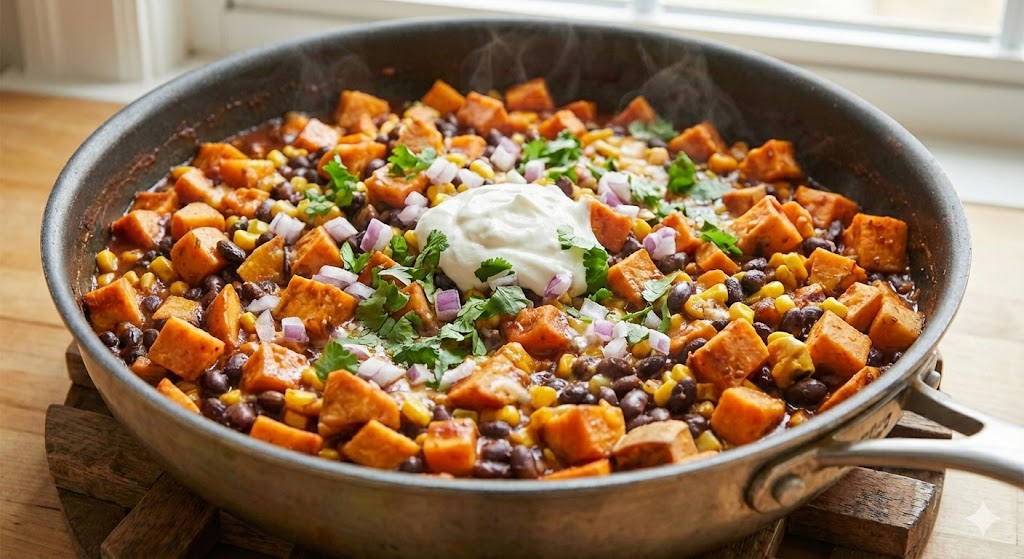
Sweet Potato & Black Bean Enchilada Skillet
There’s a certain point in the evening when the idea of rolling enchiladas stops sounding comforting and starts sounding like a chore. Not because it’s hard — it isn’t — but because it asks for a kind of patience I don’t always have at the end of the day.
This Sweet Potato & Black Bean Enchilada Skillet came out of that feeling. I wanted the flavor and warmth of enchiladas without lining up tortillas, turning on the oven, or committing to something that would leave me scrubbing pans later. I wasn’t trying to simplify enchiladas on purpose. I was just trying to get dinner on the table without resenting it.
It turned out to be a version I reach for more often than the rolled kind.
Sweet potatoes need more respect than they usually get
I didn’t always like sweet potatoes in savory dishes. Early attempts were either too soft or oddly sweet in a way that felt out of place.
The problem wasn’t the ingredient. It was how I was cooking it.
Sweet potatoes need time with the pan before anything wet touches them. Sauce too early and they steam. Cut too small and they collapse before they’ve picked up any flavor.
Now I cut them into medium chunks — bigger than bite-sized, smaller than roast potatoes. I want surface area, but I also want them to hold their shape long enough to brown.
I salt them lightly at the beginning, not aggressively. Sweet potatoes amplify salt as they cook, and I’ve learned that fixing oversalting later is nearly impossible once the sauce is in.
Black beans aren’t just there to fill space
For a long time, I treated black beans as a given. Open can. Drain. Add.
They were fine, but forgettable.
What changed things was realizing they benefit from the same treatment as the sweet potatoes — heat, space, and restraint. I drain and rinse them, then let them sit on a towel for a few minutes. Not because I’m disciplined, but because wet beans cool the pan and kill browning instantly.
When they go into the skillet, I let them sit untouched for a moment. They pick up a faint crust and lose that canned softness. It’s subtle, but it gives the dish more texture than you’d expect.
I didn’t believe it would matter until I tasted the difference.
About enchilada sauce (and why I stopped being precious)
Most of the time, I use store-bought enchilada sauce. Not the cheapest one, not the fanciest. Just one that tastes balanced and isn’t overly sweet.
I’ve made homemade sauce for this skillet. It’s good. It’s also not what determines whether the dish works.
What matters more is consistency. Too thick, and it coats instead of integrating. Too thin, and everything turns soupy.
If it’s thick, I thin it with water or broth. Just enough so it flows. I don’t want it drowning the skillet. I want it clinging.
I used to pour it all in at once. Now I add most of it, stir gently, then decide if it needs more. That pause saves the dish more often than any measurement ever did.
How this skillet actually comes together (without rushing it)
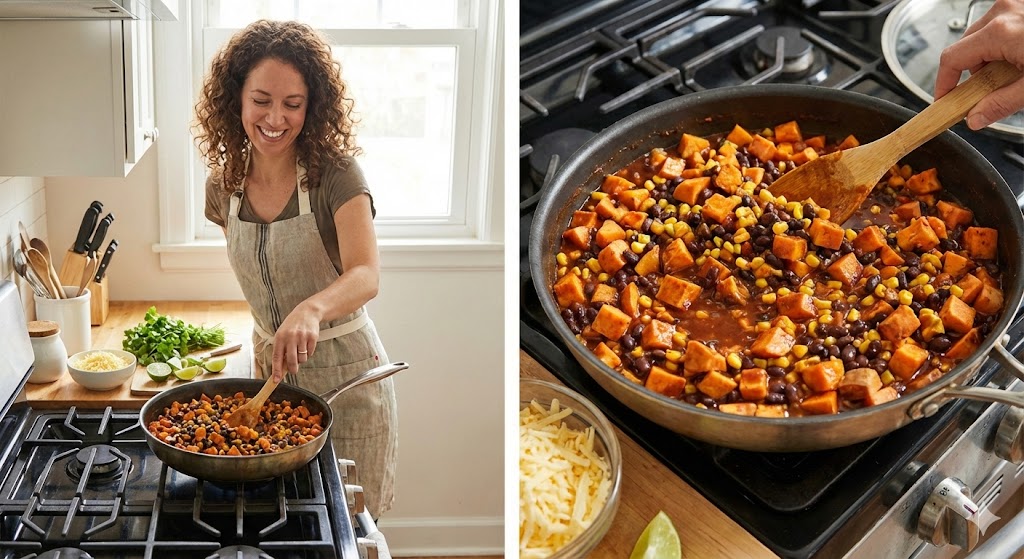
I start with a wide skillet over medium heat and enough oil to coat the bottom. Sweet potatoes go in first, spread out as much as the pan allows. If they overlap a little, I don’t panic — but I don’t crowd them.
Then I leave them alone.
This is the part that feels slow. I’ve tried speeding it up. Every time, I regretted it. Browning takes longer than you think, especially with dense vegetables.
When the sweet potatoes start to release and pick up color, I flip them and let the second side cook. Only when they’re nearly tender do I move on.
I push them to one side and add the black beans, a little more oil if needed. Same rule: let them sit, then stir.
At this stage, the skillet smells warm and earthy, even before the sauce appears. That’s how I know it’s ready.
Then the enchilada sauce goes in. I lower the heat slightly and stir just enough to coat everything. I don’t simmer it hard. I let it settle.
Cheese is a choice, not a requirement
I almost always add cheese, but I don’t treat it as the main event.
I sprinkle it over the top once the heat is low and cover the pan just long enough for it to melt. I don’t stir it through. I like pockets — melted here, barely there.
Too much cheese turns this into something heavy and dull. I’ve done that version. It tastes fine for three bites, then you’re done.
Moderation keeps it flexible.
Tortillas: in the skillet or on the side
I’ve torn tortillas directly into the skillet before. It turns the whole thing soft and casserole-like. Sometimes that’s what I want.
More often, I keep tortillas on the side. Warmed, torn, used to scoop. That way, I control how much goes into each bite, and nothing gets soggy unless I let it.
Neither approach is wrong. I stopped treating it like a decision that needed defending.
Small additions that come and go
This skillet changes depending on what’s around.
Sometimes onions go in early with the sweet potatoes. Sometimes bell peppers. Occasionally corn, which adds sweetness but also brightness.
I finish with lime juice more often than not. Just a squeeze. It doesn’t make the dish taste like lime — it just sharpens everything slightly.
Cilantro is nice, but I don’t miss it when it’s not there.
How I usually eat it (and how I stopped over-complicating it)
I usually eat the first serving straight from the skillet. Standing, fork in hand, deciding if it needs anything else.
After that, I sit down with tortillas and maybe a spoonful of yogurt or sour cream on the side. Not mixed in — on the side.
Leftovers reheat well in a pan. The flavors deepen overnight. The sweet potatoes soften a bit more, but they don’t turn mushy if you didn’t rush them the first time.
I avoid the microwave when I can. It flattens the texture too much.
Mistakes I’ve already made for you
I’ve added sauce too early. Everything went soft.
I’ve crowded the pan. Nothing browned.
I’ve oversalted at the beginning and couldn’t undo it.
Each time, the dish was still edible — but noticeably less satisfying.
This skillet forgives a lot, but it rewards patience more than anything else.
Why this one earns its place
This Sweet Potato & Black Bean Enchilada Skillet stays in my rotation because it delivers comfort without demanding ceremony. It feels complete without being rigid. It adapts without falling apart.
It’s the kind of meal I can make on autopilot now — and still enjoy eating.
Those are the dishes that last.
And this one has proven it belongs there.